

I Spent 20 Years Wishing I Wasn’t a Woman — Here’s What Changed Everything
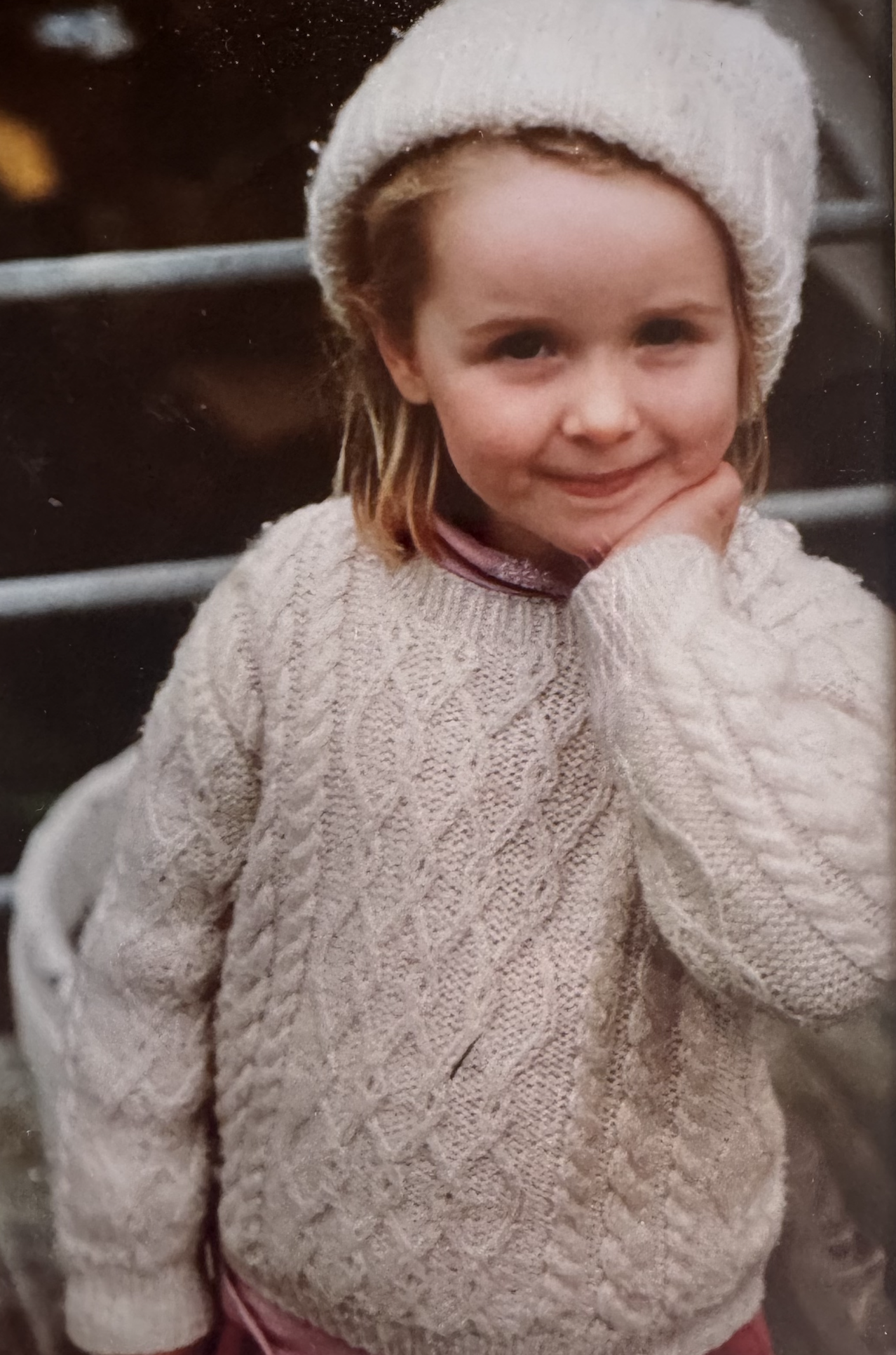
Me, before the world told me my body was something to fear.
From a Matriarchal Childhood to Fundamental Christianity
Until the age of 11, I lived in a world that honoured the body, the earth, and the unseen magic of being human. I was raised in a sex-positive, matriarchal environment and spent my early years immersed in Steiner education, a way of life that treasures the inner world of the child, the imagination, the senses, and the sanctity of embodiment.
In Steiner, learning didn’t just value the intellect; it was sensual, artistic, rhythmic. We moved our bodies, we sang, we painted, we baked bread, we touched wool, wood and clay almost everyday. We were encouraged to feel life through our hands, our breath, our skin. There was no rush to grow up, no pressure to perform and no premature intellectualisation. Childhood was protected, sacred, slow and my body was simply a natural, beautiful part of being alive.
At home, my family mirrored this earth-based way of living. My body wasn’t something to hide or fear; it was something to enjoy, explore, and take pride in. I was celebrated as a girl. Becoming a woman felt exciting, mystical and inevitable in the best possible way.
I remember counting down the years until I could join the “women’s mysteries,” imagining it the way other children dreamed of Christmas morning. I couldn’t wait for my first period. I knew it was a rite of passage, a sacred initiation and a doorway into womanhood. I was so eager that from the age of 10, I would run to the bathroom to “check,” hoping today would be the day I crossed the threshold. I simply could not wait.
However, just before puberty, my parents “found God”.
Overnight, my celebrated body became something to monitor, cover, discipline, and distrust. The earthy innocence of Steiner gave way to doctrine. The wildness and wonder I had known were replaced with rules, warnings, and fear.
Today, I want to speak to what that shift does to a little girl.
To what it meant for my body, my identity, my sense of self-worth.
To how the stories of culture, church, family, and purity shape a girl who was once deeply connected to her body and how quickly that connection can be severed.
This is the story of what happens when a child raised in freedom enters a system built on shame.
And the story of the long, slow reclamation back home to my body.
The Wild, Embodied Girl I Once Was
As a young girl, I was a natural leader and initiator. Growing up on seven acres just outside of Geelong (50 minutes from Melbourne), I would guide my friends on the most extraordinary initiatory adventures. These journeys were wild and at times, genuinely dangerous. There were risks of drowning in the dam, and the real threat of being impaled as we crossed a wire fence over water with hidden sticks beneath the murky surface…the potential danger, like any good initiation, was simply part of it.
After surviving the creek cross, I’d lead my friends into a a small cave where a fox skeleton lay baked into the dry clay dirt, and then we’d climb a up a small cliff face riddled with spiky thorn bushes to get to the Magical Tree. The beautiful old tree stretched horizontally over an old, dried river bed and the challenge was to climb across without falling because if you did, the troll would “eat” you.
If you made it through, the final trial was the Walk of Death: a long, narrow tunnel (concrete water pipe) under the road riddled with wasp nests. Survive all four challenges, and you were initiated into the wild.
I created and led these adventures from the age of five through to fifteen, taking my city-kid friends on these epic rites of passage for a full decade.
When My Body Became “Sinful”: Age Ten
When my parents became fundamental Christians (the type where you have to speak in tongues in order to be saved) and my body suddenly became a place of sin, all of that embodied magic started to fade - the fairies, the trolls and the heroine stories disappeared from my life.
Overnight, I learned that boys and men held the power, and women existed to be subservient. Men were “the head of the household.” Perhaps that wouldn’t have been so bad if the men in those positions had been consistently kind, wise, protective, and respectful.
But that wasn’t the reality I witnessed. Instead, I saw men making harmful (and unwise) decisions while their wives quietly complied, having little say because obedience to their husbands was mandatory and final.
The imbalance between men and women was undeniable. The only difference I could see was anatomical: one was born with a vulva and the other with a penis that dictated an entire hierarchy. That hierarchy was mirrored in the church too: no female pastors, no female teachers, no female leadership of any kind. It was entirely male.
I began to realise I was living in a world where men had privileges women simply did not, and that I was profoundly disfavoured because I had been born female. I went from a childhood where my body was celebrated to, in a matter of months, to feeling robbed and utterly disadvantaged by being born a girl. I internalised the belief that my body was inferior, that I would have fewer opportunities, and that my voice mattered less because I would never be a man. Worse, I was taught that women were responsible for the suffering in the world because Eve had caused Adam to sin.
Any time I expressed an opinion or behaved in a way that didn’t align with the church or my parents, the shame came swiftly: You’re being like Eve. You’re tempting men. You’re going to make a man stumble. Or, even more damning, Don’t be a jezebel - a witch. The correction was always a comparison to a “dangerous woman.”
Despite the presence of a of remarkable, complex, world-shifting women in the Bible, the church I grew up in rarely spoke their names. Their courage was softened, their power minimised, their agency erased. Instead, we were fed a steady diet of male triumph including kings, prophets, warriors, patriarchs, disciples and apostles.
But the text itself tells a different story.
Women were judges and prophets.
Women negotiated peace, orchestrated escapes, sheltered spies, and toppled empires.
Women midwifed entire nations, safeguarded lineages, carried sacred wisdom, and spoke truth to power when no one else dared.
Deborah led armies.
Jael ended wars with a single strike.
Esther rewrote political destiny.
Rahab saved her entire family and secured her place in the lineage of Jesus.
Mary Magdalene became the first witness (the apostle to the apostles) entrusted with the message that Jesus had risen…
…these stories were there all along, shimmering beneath the surface, yet the church chose not to centre them. And so many girls like me, grew up thinking feminine power was peripheral, secondary, or sinful. When in reality, the sacred text is threaded with women who led with intuition, strategy, embodiment, sensuality, and fierce devotion.
Their presence has always been a quiet rebellion and reminder of us that the feminine has never been passive, just unacknowledged.
Internalising Inferiority: Becoming a Teenage Girl in a Patriarchal System
So I entered my teen years feeling deeply irrelevant, and on top of that, I didn’t feel beautiful which only compounded the sense of inferiority I was already feeling. I was the “lesser” sex, and I didn’t meet the beauty standards that, in my family and in the wider culture, determined a woman’s worth.
In a household where a girl’s value was tied to her attractiveness (and I had a really hot sister) I clung to the one thing I did have: my intellect. I loved learning, and I was good at school, so I poured everything I had into being smart. My identity became entirely wrapped in academic achievement. If I couldn’t be desirable, at least I could get straight A’s.
But the deeper I anchored myself in intellect, the further I drifted from my heart, my intuition, my body and from the fearless, wonder-filled girl who once led other children through wild rites of passage. Like so many girls raised under patriarchy, I learned to live from the neck up, disconnecting from the very parts of me that made me feel alive, connected to nature, to the seasons and to my own sensuality.
And once you internalise that being a girl makes you “less,” the next part becomes almost inevitable.
Why Women Grow Up Wanting to Be Men (and Men Rarely Want to Be Women)
Well into my twenties, I found myself asking men this question: “Do you ever wonder what it would be like to be a woman? Would you want to be a woman for a day?”
Not once, not a single time, has a man answered yes to me.
But when I flipped the question and asked women if they’d want to experience being a man for a day, I have never heard a woman say no. Every single woman has said yes, often with a soft laugh of recognition, or a sigh, or a quiet, aching “God, just to know what it feels like…”
This contrast is not random.
Men rarely want to inhabit a woman’s body because the narrative they’ve absorbed is that womanhood is inconvenient at best, dangerous at worst, full of pain, complexity, emotional labour, responsibility, and scrutiny. They are taught to observe our experience, but never necessarily to value it.
Women, on the other hand, are raised in a world that repeatedly tells us that being female is a disadvantage - physically, socially, economically, emotionally, spiritually. We grow up seeing men freer, safer, louder, more believed, more resourced, more rewarded. We grow up absorbing the silent curriculum of girlhood:
Men get listened to.
Men get respected.
Men get freedom of movement, freedom of rage, freedom of desire.
Men get safety.
Men get space.
And so of course women want to know what it feels like to live in a body that the world does not micro-police or mistrust. To walk down a street without scanning for danger. To take up space without apology. To express desire without stigma. To have a libido that isn’t pathologised. To have anatomy that society openly studies, names, acknowledges.
We’ve been conditioned to believe that being a man is easier, safer, more straightforward, more powerful and that being a woman is inherently burdensome.
And how could we not internalise that, when it’s the story handed to us everywhere: in media, religion, family dynamics, schoolyards, medicine, history, and culture?
This isn’t about wanting to be male.
It’s about wanting the freedoms that women have been denied.
It’s about wanting access to a life unburdened by shame, scrutiny, silence, or danger.
It’s about wanting to know, just for one day, what it feels like to live without the weight of societal lies we were never meant to carry.
The Missing Science: How Modern Medicine Failed Women’s Bodies
One of the biggest game changers for me has been learning the biology. Our cultural misunderstanding of women’s bodies isn’t a coincidence; it’s the direct result of centuries of scientific neglect. For most of medical history, women’s bodies were considered “too complicated” to study because of our hormones. Researchers wanted clean, predictable data and so they used male bodies as the default template for all humans. Women were considered a deviation from the norm.
It wasn’t until the 1990s, shockingly recently, that medical research even began studying women with natural hormonal cycles. Before that, the vast majority of research involving women was conducted only on postmenopausal women so their hormones would be “stable.” The findings from these studies were then applied to all women, including teenagers, women in their twenties, pregnant women, postpartum women — anyone with a cycling hormonal system. It was treated as if all female bodies were the same.
It sounds unbelievable, but it’s true: Up until the 90s, women with menstrual cycles were essentially excluded from medical research.
The consequences of that are enormous. It means everything from medication dosage, to symptom presentation, to diagnostic criteria, to stress responses, to pain thresholds, were all built around the male body. Women were expected to simply cope, fit the model, or be labelled “mysterious,” “unstable,” or “complicated.”
And then there’s the clitoris, the most densely innervated organ in the human body, designed purely for pleasure. Despite this, its full internal structure wasn’t even mapped until 1998 by urologist Helen O’Connell. Think about that: We put people on the moon in 1969, but we didn’t bother to fully map the clitoris until almost 30 years later.
When you take all of this into account the lack of research on cycling women, the erasure of female anatomy, the male-default medical system it becomes painfully clear why we’ve internalised so much shame, confusion, and disconnection. We have been living in a world that has never truly studied us, understood us, or taught us about our own biology.
We’ve been conditioned to believe our bodies are the problem, when the real problem is the missed understanding.
Discovering My Cycle: Learning the Truth About Female Biochemistry
In 2023 I read In the Flow by Alisa Vitti. If you haven’t read it, I truly encourage you to because it reveals something our culture never taught us: female biochemistry is radically different from male biochemistry. Our entire world is structured around the 24-hour male circadian rhythm, a rhythm where testosterone peaks in the morning, declines gently throughout the day, and resets each night. This works beautifully for male bodies.
But women don’t operate on a 24-hour cycle.
Our primary hormonal rhythm is infradian, a 28-day cycle (give or take).
This system governs our energy, metabolism, cognition, mood, creativity, and physical capacity differently every single week.
Yet we are expected to live, work, produce, perform, and regulate ourselves as if we have the same 24-hour chemistry as men.
The repercussions are enormous.
No wonder women feel burnt out.
No wonder we feel like we’re “failing.”
No wonder our PMS is worsening, our stress is chronic, and our bodies are screaming.
We are living against our biology.
Learning this changed everything for me. I realised there are phases each month where I can genuinely 10x my output, and others where my body is asking, clearly for slowness, rest, and introspection.
The Four Phases (According to Vitti’s Work):
Follicular (Inner Spring)
Your brain fires with new ideas. Creativity is high. Motivation rises. This is the perfect time to begin projects, plan, and take action.
Ovulation (Inner Summer)
Communication skills peak. You’re magnetic, social, expressive, productive. This is your natural high-performance window.
Luteal (Inner Autumn)
Task-finishing becomes easier. You gain clarity around boundaries. But this is also where you must slow down, nourish, and prepare for your inner winter — or PMS will roar.
Menstruation (Inner Winter)
Your brain connects hemispheres more powerfully. Insight is heightened. Historically, women retreated here — not because they were “weak,” but because they were visioning for the tribe, returning with clarity and guidance.
This is a time for rest, reflection, and recalibration.
And when we don’t rest, when we continue pushing, producing, and performing like we’re in an ovulatory state all month long our bodies can revolt. PMS intensifies. Irritability spikes. Exhaustion becomes chronic. We get labelled “emotional,” “unstable,” or “crazy,” when in truth, we’re simply misaligned with our hormonal design.
Reading In the Flow helped me understand not just my cycle, but my brain. How female brains are wired for connection, discernment, empathy, long-term thinking, and community protection. How we’re not built to “react and dominate,” but to hold, attune, and lead from relational intelligence.
And suddenly, everything made sense. My exhaustion made sense. My shame made sense. My frustration made sense.
I wasn’t broken. I was living as if I had a male body in a world that only honours the male rhythm.
The Strength of Women: What We Were Never Told
When we begin to understand the truth of women’s biology, women’s psychology, and women’s place in human history, something extraordinary becomes clear: women have always been powerful, far more powerful than we were ever taught to believe.
Not powerful in the narrow, hyper-masculine sense of brute force, but powerful in the ways that have sustained humanity for millennia: connection, endurance, community, intuition, empathy, protection, and the ability to rise after unthinkable devastation.
In The Power of Women, Dr Denis Mukwege, describes his work in the Democratic Republic of Congo treating female survivors of the most heinous and brutal sexual violence imaginable. He speaks to the power of women rebuilding communities and restoring their dignity after atrocities most of us cannot even imagine. He reveals something Western culture has long overlooked: women’s capacity to survive, rebuild, lead, create, and love after profound harm is one of the most extraordinary forces on earth.
What Happens to Women’s Vulvas in The Power of Women
Dr Mukwege explains that in the context of Congo’s conflicts, rape is used not as an act of individual violence but as a weapon of war, a deliberate strategy to terrorise, destroy families, and dismantle entire communities.
The injuries he sees are extreme forms of genital trauma, far beyond what most people imagine when they hear the word “rape.”
Women’s vulvas are subjected to severe tearing and extensive internal injury, often requiring complex reconstructive surgery.
Armed groups frequently use weapons or objects, causing damage that is both physical and life-threatening.
Some survivors have injuries so extensive that they lose control of basic bodily functions (fistulas).
Others face long-term complications such as chronic pain, infection, infertility, and difficulty walking or sitting.
Many require multiple surgeries over many years to restore even partial function and to reduce pain.
Dr Mukwege emphasises that these injuries are intended to destroy a woman’s body, her sense of self, her standing within her community, and her ability to bear children.
Yet, despite catastrophic trauma, many:
heal physically
start businesses
care for their children
support other survivors
He calls these women “the true heroes,” and believes they reveal a deeper truth about the strength of women’s bodies, spirits, and capacity for connection and healing. These women go on to:
buy land
rebuild villages
advocate for justice
reweave community life from the ashes
They become the backbone of their societies because their resilience is indescribably strong.
And this is not a story unique to the women of Congo. Mukwege is clear that violence against women is a global issue, from war-zones to university campuses. What is different is that women’s strength, their survival, their capacity for communal healing is often invisible in Western narratives.
When you read Dr Mukwege accounts, you see something unmistakable: Women’s endurance is not accidental. It is biological, spiritual, and communal.
Interestingly, when male bodies experience similar harm, it often leads to catastrophic psychological collapse (often resulting in death).
Why Comparable Genital Trauma Impacts Men and Women So Differently
What Dr Mukwege’s work reveals is not that men are “weaker,” but that male and female bodies and the cultural meanings attached to them carry different psychological stakes when injured.
When women in Congo experience severe genital trauma, the injuries are often catastrophic. But what astonishes Mukwege is that so many women continue to fight for life. They cling to their children, their community, their purpose. They rebuild. They reorganise. They find meaning even through devastation.
He describes it as a kind of relational resilience not because the trauma is any less horrific, but because women’s identities, historically and culturally, are not tied to a single organ.
But when male genital trauma occurs, in war or otherwise, something very different tends to happen.
Dr Mukwege writes that men often experience psychological collapse so profound that survival becomes unlikely. Many cannot imagine a life beyond the injury. Their identity, sexuality, status, and sense of self are so deeply interwoven with the penis that losing it feels like losing their manhood, their power, their worth their very reason to live.
Why this difference appears in the literature and in clinical experience:
1. Men are taught that their manhood is their penis.
From adolescence onward, masculinity is tied to virility, erection, potency, sexual performance, and penetration. When the penis is harmed, the psychological meaning is:
“I am no longer a man.”
2. Women have been forced, historically, to build identity around more than anatomy.
Women’s bodies have been controlled, harmed, and politicised for centuries. And yet their identities, culturally and communally, are spread across motherhood, caretaking, relational bonds, creativity, spirituality, resourcefulness. Their worth has always had to stretch beyond bodily integrity because the world has not protected their bodily integrity.
3. Social permission to collapse is gendered.
Women are allowed to receive care, to be held, to mourn. Men are often not. So when a traumatic injury strikes at the core of masculine identity, many men have no emotional scaffolding to survive it.
4. Clinical records show stark differences in outcomes.
Mukwege notes that when men suffer comparable genital injuries in conflict zones, mortality rates skyrocket, not just from physical harm but from psychological despair. He describes men who “give up the will to live” within days.
This is not because men are inherently fragile, but because their identities are culturally condensed around one organ, and because society does not teach men how to rebuild identity when that organ is harmed.
5. Women’s communal healing structures are stronger.
Women heal together.
They form groups.
They share stories.
They lean on one another.
Even in devastation, they find meaning in connection.
Men, culturally, often heal alone or not at all.
The truth underneath all of this
What Mukwege’s work reveals a truth about storytelling: Women are told from birth that they are more than their genitals.
Men are told from birth that they are their genitals.
So when the worst happens:
Many women rebuild their identity
Many men lose theirs
This difference is heartbreaking, telling, and deeply reflective of the cultural myths we hand to children long before they understand them.
Yet, women, supported by other women, held in community, honoured by care often recovered in ways that defy logic. They transformed pain into activism, into leadership, into rebuilding, into fierce and grounded love.
This is not to glorify suffering, suffering should never be required of anyone. Rather, it reveals how profoundly we have underestimated ourselves.
It made me question everything I had been taught about being “the weaker sex.”
How could women be the weaker sex when they are the ones who rebuild nations? How could women be lesser when they carry life, sustain life, nurture life and when they choose not to, they use that same creative energy to build businesses, shape communities, innovate, imagine, and love? How could women be inferior when their entire physiology is designed for resilience and long-term thinking, for the survival of the whole?
And how could any girl grow up believing she was unlucky to be female?
Yet that is exactly what happens when:
the science of female bodies is erased,
the wisdom of female biology is ignored,
the truth of women’s resilience is hidden,
and girls are taught shame instead of sovereignty.
This is why learning the truth about my body, my biology, my cycle, my pleasure anatomy, has been life-altering. Reading Vitti’s work, sitting in circle with women for the last three years, and studying Integrative Sex Coaching has revealed what should have been obvious all along: I am profoundly grateful to have been born in this female body.
And the more truth I learned, the more layers of shame began to dissolve, shame inherited from purity culture, from the obsession with virginity, from being watched, judged, and controlled. Shame that was never mine to carry.
This is what knowledge does.
This is what reclamation does.
This is what returning to the truth of women’s bodies does.
The Cost of Cultural Lies: Growing Up Hating My Female Body
Purity culture taught me to fear my own desire.
I learned that God was always watching me.
Watching my thoughts, watching my body, watching my pleasure. Masturbation, self-touch, sex outside of marriage… everything was framed as sin. Everything carried the threat of punishment (hell), shame (you’re unloveable), or abandonment (you’ll be kicked out and homeless).
I was told that if I had sex before marriage, no man would ever want me. That I would be “used goods.” That my worth depended entirely on being desired by a man, while simultaneously being warned never to “tempt” one. I carried the impossible responsibility of preventing male sin.
It created a violent disconnect between me and myself. My body felt wrong. Evil. Untrustworthy. Something I had to hide, shrink, protect and police.
For most of my teenage and adult years, I was deeply uncomfortable with my breasts. I didn’t want them seen. I didn’t want to be perceived as sexual in any way.
Even now, I sometimes catch my reflection and think, You have beautiful breasts, only to immediately feel shame. The discomfort is still there and the imprint of a childhood spent believing that visibility equated to danger, and sexuality equated to sin lingers on.
I’m working on it. But it shows how profoundly these teachings burrow into us, how long it takes to peel back the layers, to reclaim the parts of ourselves that were never wrong in the first place.
The Truth About the Hymen: What I Wish I Knew Earlier
When I first read about the hymen in Emily Nagoski’s book, Come As You Are, I cried.
Learning about this tiny part of my body is the most freeing biology lesson I have ever received.
That is, the actual truth about the hymen. Truth I wish every girl was told long before puberty hits, long before the shame, and long before purity culture rewrote our biology into a morality tale.
Growing up Christian, my entire worth was tied to the state of a body part no one even understood. Virginity was taught as a fragile seal, a moral badge, a measure of my worth, value and lovability. The message was clear: If the hymen was “intact,” I was good. If it was “broken,” I was ruined (unless of course happened it after marriage, in which case it was a cause for celebration).
Even when I stopped believing in God, the conditioning stayed.
I still felt watched.
I still feared being “dirty.”
I still expected punishment.
And perhaps most heartbreakingly: I expected blood (fortunately, for me there wasn’t any, because my first time was actually pretty positive).
What the Hymen Actually Is (and Isn’t)
The hymen is not a seal. It is not a barrier. It is not proof of anything.
Biologically speaking:
The hymen is a thin, stretchy membrane around the vaginal opening, not across it.
It has no known biological function.
It naturally opens before or shortly after birth so menstrual blood can pass. And if it doesn’t it has to be surgically opened to allow for menstruation.
During puberty, estrogen makes it thicker, softer, and more elastic, not more fragile.
It has very few nerve endings and blood vessels, which is why it does not typically rupture.
The hymen’s appearance is highly variable among women and changes throughout life.
Pain or bleeding during first-time penetration is not because the hymen “broke.”
It is more often due to:
lack of arousal
dryness or insufficient lubrication
tension in the pelvic floor
rushed or forced penetration
tears to the vaginal wall or fourchette, not the hymen
The hymen cannot be used to determine virginity (it never could).
Virginity Is a Cultural Idea - Not a Biological One
Virginity is a social construction, mostly used to control women’s sexuality.
Yet entire cultures still rely on the myth:
Families displaying blood-stained sheets the morning after the wedding
Girls in parts of the world undergoing hymen reconstruction surgeries to protect their “honour” and literally to survive.
Virginity testing, widely condemned by the WHO, but still being performed
Women judged, shamed, punished, and even harmed over a piece of tissue that tells us nothing
And in Western culture, the shame simply shapeshifts into silence, fear, purity pledges and rings (yes, I had one), and the unspoken expectation that a “good girl” doesn’t enjoy sex.
When I learned that blood during first-time sex usually means one thing, she wasn’t ready, she wasn’t aroused, or she wasn’t cared for, I cried (again),
I cried for myself.
I cried for every girl who thought pain was normal.
I cried for every woman who learned to equate her worth with her wound.
What Every Girl Should Be Told Instead
You are not “losing” anything the first time you have sex.
Nothing is taken from you.
You do not become less pure, less whole, or less worthy.
You are simply having a new experience, one that deserves pleasure, safety, readiness, and choice.
But because we are never taught this…
Because we are taught only fear and silence…
Generations of women enter sex disconnected from their bodies, unaware of what pleasure feels like, and conditioned to believe that pain is normal.
And when you expect pain, you tolerate pain.
When you assume sex “should hurt,” you don’t speak up.
You don’t say stop.
You don’t say slow down.
You don’t say I need more time, more care, more softness.
For me, reclaiming my hymen, through this knowledge, has helped me understand that my body was never the problem.
The Global Cost of Controlling Women’s Bodies: Introducing FGM
If the hymen myth is one way culture has tried to control girls’ bodies, then Female Genital Mutilation is the most brutal expression of that same belief system.
Female Genital Mutilation (FGM) is an umbrella term for any procedure that involves cutting, removing, or injuring the external female genitals. It is recognised globally as a violation of the human rights of girls and women.
More than 230 million girls and women alive today are estimated to have undergone some form of FGM. The majority live in African countries, where over 144 million have been affected. Across Asia, the number is estimated at more than 80 million, with a further 6 million in the Middle East.
Smaller practising communities also exist throughout Europe, North America, Australia, and other regions due to migration, meaning FGM is not confined to any one place or culture.
Where the hymen myth teaches girls to fear their sexuality, FGM is designed to remove a woman’s capacity for sexual pleasure and desire, and to enforce an ideal of “purity” rooted in control.
It is framed as culture.
As tradition.
As a rite of passage.
In countries such as Somalia, Djibouti, and parts of the Horn of Africa, prevalence rates of FGM are extremely high, in some regions above 90%. Young girls, as young as five, may be cut with razor blades, knives, or other sharp tools, often without anaesthetic, without consent, without any understanding of what’s happening to them.
The Physical Reality: What FGM Leaves Behind
The harm extends far beyond the moment of cutting.
Because the procedure is usually performed without sterile equipment or pain relief, the immediate risks are profound:
severe bleeding, intense pain, infection, urinary retention, difficulty walking, and even death.
Long-term consequences can include:
permanent scarring
chronic pelvic pain
recurrent infections
painful periods
difficulties with urination
pain during sex
complications in pregnancy and childbirth
challenges with arousal and orgasm, depending on what tissue was removed
For girls subjected to the most extreme forms, where the labia may be sewn together, even menstruation and urination can become painful, prolonged, or dangerous.
FGM in Australia: What it actually looks like
Many people assume FGM is a “far away” issue, something that happens only in remote villages or war-torn regions.
But when I worked as a teacher, we were trained to recognise the signs of FGM in girls in Australian classrooms.
Let that land.
While exact numbers are difficult to determine, partly because FGM is hidden, and partly because many survivors never disclose, estimates suggest that thousands of girls and women living in Australia today have undergone FGM overseas before migration, and hundreds are considered at risk within certain communities.
Major hospitals in Melbourne, Sydney, Brisbane, and Perth have all reported caring for women and girls with FGM-related injuries.
What training looks like for teachers, nurses, and frontline workers
Australian educators and health professionals receive training that covers:
How to recognise physical signs of FGM (especially during routine health checks or school wellbeing assessments)
Behavioural indicators in children, such as anxiety around toileting, difficulty sitting, pain when walking, or unexplained absences following school holidays
Mandatory reporting obligations, because FGM is classified as a form of child abuse
How to respond compassionately without shaming the child or the family
How to access specialised medical, psychological, and social supports for girls who have been affected
Understanding cultural complexity, including how migration pressures, community expectations, and fear of stigma shape these decisions
Some schools and healthcare settings also run “holiday risk” briefings, because the highest danger period is when girls may be taken overseas to visit extended family.
Is FGM being performed inside Australia?
FGM is illegal in every state and territory, including taking a child overseas for the procedure. Because of this, cases performed on Australian soil are extremely rare and usually prosecuted when discovered.
Most affected girls have been:
Cut before arriving in Australia, or
Taken overseas during school holidays for the procedure under cultural pressure.
The secrecy surrounding FGM means it is not always clear who performs the cutting, but typically:
It is carried out by traditional practitioners overseas, or
In some regions, by midwives or local healers in the community of origin
There is no known evidence of mainstream healthcare practitioners in Australia performing FGM.
FGM is not “elsewhere” it is here, in diaspora communities
And this is what so many people don’t realise:
FGM isn’t something that happens “over there.”
It travels with migration, tradition, culture, and identity.
It exists in the suburbs where we buy groceries.
In the schools where our children learn.
The psychological undercurrent is the same
Whether it’s happening in a remote village or behind closed doors in a Melbourne townhouse, the belief underneath FGM does not change:
When a girl’s pleasure is seen as dangerous, it becomes something to control.
When her sexuality is viewed as shameful, it becomes something to punish.
When her desire is deemed threatening, it becomes something to silence.
The Shared Psychology Behind All of It
If FGM is the most violent end of the spectrum, then purity culture, slut-shaming, hymen myths, and porn-as-education are its quieter cousins.
Different methods.
Same outcome.
Women who don’t know their bodies.
Women who don’t know their pleasure.
Women who don’t know their power.
Because once you take away a girl’s pleasure literacy, you take away her sovereignty.
You take away her ability to say yes from the body, and no from the body.
You take away her ability to protect herself.
This is how we end up with generations of women who enter sex expecting pain, tolerating discomfort, and abandoning themselves because they were never taught anything else.
Why Girls Are Set Up to Suffer: Painful Sex, Porn & Lack of Pleasure Literacy
How did we become a society where pain is anticipated and pleasure is a mystery? How is it that we are still not teaching girls (and boys), explicitly, that sex is meant to feel good, not something they must endure?
If girls were told from the beginning that pleasure is the baseline, then the moment something felt wrong, they would know to stop. They would be more likely to speak up. They would know their bodies weren’t broken (the situation was).
But when we teach them that sex will likely hurt, that pain is part of the experience, they learn to override their instincts. They learn to tolerate discomfort. They learn to disconnect from their own signals.
They learn to abandon themselves.
Meanwhile, in some cultures, such as the Baganda community in Uganda, girls are not left to step into womanhood alone. Within the Ssenga tradition, the father’s sister becomes a young woman’s guide, a private, women-led lineage of sexual and relational education that stands in powerful contrast to the silence many of us inherited in the West.
Research into this tradition shows that Sengas speak openly with girls about sexual feelings, desire, pleasure, and how sex may feel in the body. They teach young women how to recognise satisfaction, how to communicate their needs, how to express discomfort without shame, and how to negotiate intimacy with clarity.
These teachings are passed down through stories, humour, metaphor, dance, symbolic gestures, and demonstrations using objects, embodied wisdom shared through relationship.
And when researchers partnered with Sengas to support adolescent girls, they observed that girls who received Ssenga-led education developed:
stronger sexual communication skills,
greater confidence in voicing boundaries,
increased use of protection,
and significantly lower rates of HIV and STD symptoms.
What Western sex education does with diagrams and fear-based messaging, these aunties achieved through connection, conversation, and trusted female guidance.
Like many cultural practices, Ssenga tradition isn’t perfect. It has come under criticism for reinforcing patriarchal expectations around marriage, sometimes for upholding norms that prioritise male pleasure, and sometimes for being shaped by beliefs that do not reflect contemporary understandings of autonomy or consent.
And yet, even with its complexities and contradictions, the heart of the Ssenga lineage remains profound: a world where women speak to girls honestly, privately, and without shame about bodies, intimacy, desire, and relationship.
A world where sexual knowledge is not an afterthought or a taboo, but part of the sacred inheritance passed down from one generation of women to the next.
Imagine a world where a girl’s first understanding of pleasure comes from the wisdom of women who want her to be safe, empowered, and sovereign in her own body.
Instead, in the West, most girls get their sex education from:
awkward sex ed lessons at schools
drunk first times
pornography
the inside pages of Dolly magazine (millennials)
Tiktok Influencers
other girls who are also guessing their way through their own shame
In schools, when it comes to sex education, we’re still telling them what not to do. We teach them how to avoid pregnancy. How to avoid STIs. How to say “no” in the most basic, mechanical sense but never how to feel into their bodies. Never how to recognise enthusiastic consent. Never how to tell the difference between “I’m curious,” “I’m excited,” “I feel safe,” and “ I’m not ready.” Imagine a world where girls are taught what a true yes feels like so they can recognise their no without hesitation.
Instead, we teach a disempowered version of anatomy but never pleasure anatomy.
We teach prevention but never desire.
We teach fear but not embodiment.
No wonder we are raising generations of women disconnected from their own erotic intelligence. No wonder their first sexual experiences are painful, confusing, dissociative and often, abusive. No wonder so many women arrive in adulthood not knowing what they like, what they want, or how to trust their own sensations and intuition.
Reclaiming My Body: From 20 Years of Self-Rejection to Deep Gratitude
This conversation has been a long time coming.
For the first time in my life, I can say, I have no desire to be in a man’s body. None. I am so fucking grateful to be in this body, in this form, as a woman.
I’m 33, and for at least 20 of those years agonising over being born female. The beginning, I was a happy, wild, embodied, free little girl. But from ten onwards, shame, conditioning, and patriarchy carved a different story into me. I spent decades looking over the fence, envying what I thought men had access to: power, ease, freedom.
Now, after everything I’ve learned, everything I’ve unlearned, everything I’ve reclaimed, I can say confidently: I am proud to be a woman. I am grateful to be a woman. I wouldn’t trade this for anything.
And I’m genuinely excited for the next chapters, for perimenopause, menopause, and all the mythic, juicy terrain that lies ahead.
I know there will be gold in it. I know there will be wisdom that was hidden. I know there will be conditioning to dismantle and truths to uncover. Just like every other phase of womanhood, I trust it will reveal strength, power, intuition, and a depth of self-love I haven’t yet tasted.
For so many years, I was taught to believe that being female made me lesser.
Now I know it is the source of my power.
The foundation of my intuition.
The root of my creativity.
The home of my Eros.
And the place where my soul feels most alive.
I hope this for all women, everywhere.
For the Woman Who’s Ready to Come Home to Her Body
If this story stirred something in you…
If you felt the ache of recognition, or the spark of possibility…
If you’re tired of carrying shame that was never yours to begin with…
…I want you to know: you’re not alone.
If you feel the pull to reconnect with your body, soften into your femininity, and experience healing in a space where you are deeply witnessed, I invite you to join The Wonderfully Wilde Women’s Collective, a monthly online circle opening in 2026.
If you feel called toward deeper, more personalised support, you can explore Online Sex Coaching for Women a gentle, trauma-informed space to unravel shame, rebuild pleasure, and rediscover the woman you were always meant to be.
And if you want embodiment practices, rituals, meditations, and stories of feminine reclamation, you can explore the full Sabina Wilde Blog here.
With wilde tenderness,
Sabina Wilde xx
